Background
Cultural inertia causes societies to crave the comfort of continuity rather than assertively adapt to change. In the Middle Ages, both Church and State wanted their institutionalized executive to outlive whoever was the transitory incumbent[1]. The phrase, "The King is Dead, Long Live the King"[2], distinguishes between the eternal aspect of kingship as an enduring institution or office and the mortality of a particular human being.
Examples
The concept of an honorable Office that continues past the death of the current office-holder applied throughout the Middle Ages to Pope, Emperor, and some lower titles, such as Archbishop or Earl.
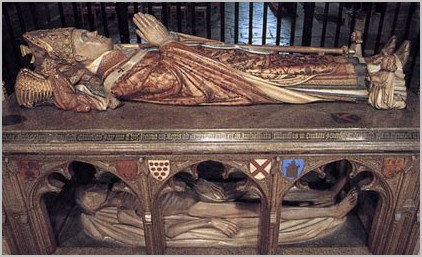
Consider the Archbishop of Canterbury, Henry Chichele, who died in 1443. Henry’s tomb in Canterbury Cathedral consists of two layers. The upper figure depicts Henry as Archibishop, wearing fancy clothing and in prayer. The lower figure shows a naked cadaver[3].
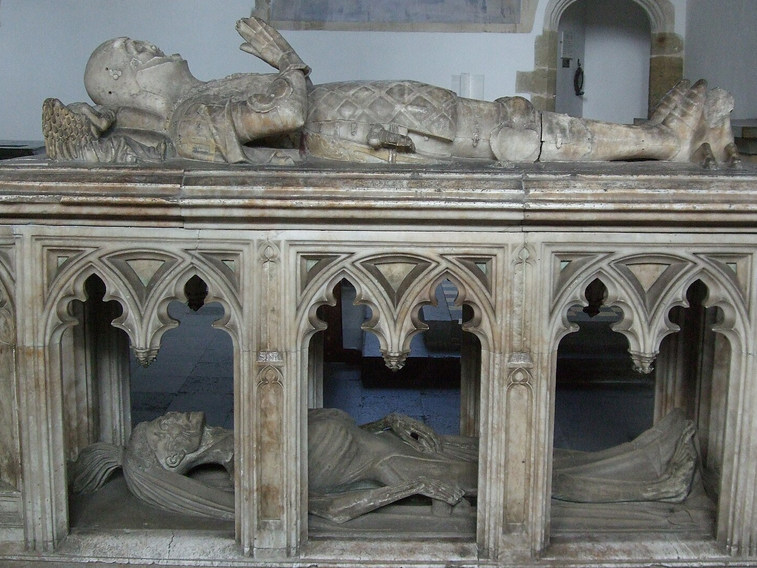
We could also say "The Earl is dead; long live the Earl". For example, John Fitzalan, 6th Earl of Arundel, died in 1421. Therefore, his eldest son, also named John Fitzalan, became the 7th Earl of Arundel. In 1435, the 7th Earl of Arundel, died. This 7th Earl has a two-layer tomb in Arundel Castle, where the upper level shows the Earl in prayer, protected by armor, and the lower level shows the almost naked body helplessly exposed. [4].
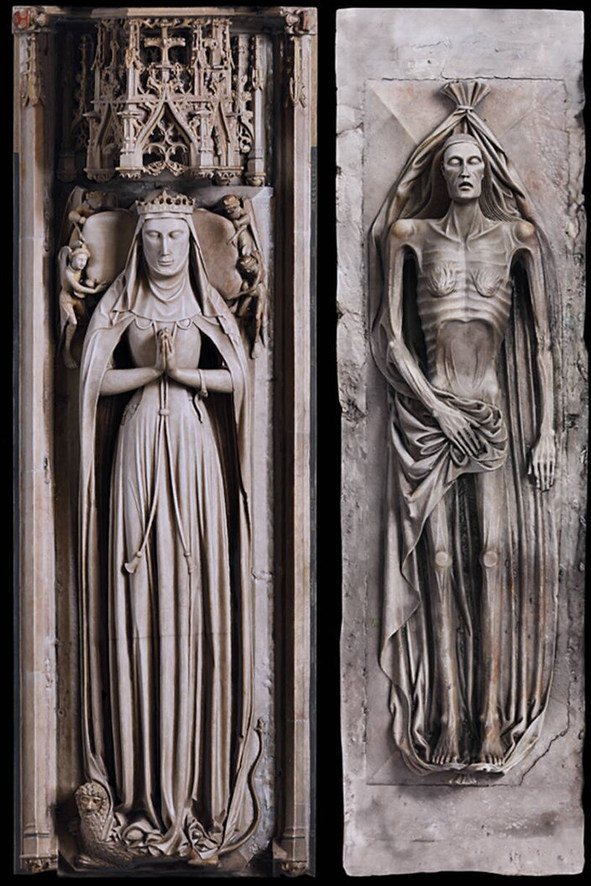
Alice Chaucer, Countess of Pembroke and grand-daughter of Goeffry Chaucer, who died in 1475, has a two-level tomb. In honor of her status as a Countess, the upper level shows her eternal presence in solemn prayer with angels, and, in tribute to the virtue of her religious humility, the lower level shows a bare-breasted emaciated cadaver.[5]
Incidentally, this deference to the Office an office-holder holds is evident when attorneys in a law court address the judge as "Your Honor". This is a reference to the eternal role that the presiding judge is enacting. "Your Honor" is for the judge’s role and robe. "Your Honor" is for the general persona, not the particular person.
Neo-Medieval Embodiment
Later historical periods, such as the Renaissance, the Englightenment, and the Age of Republican Revolutions against the Divine Right of Kings, outgrew the political theology of the Middle Ages.
However, it seems the United States, a republic that began in the 18th century, has been reverting to a period it never experience in the first place, the Middle Ages.
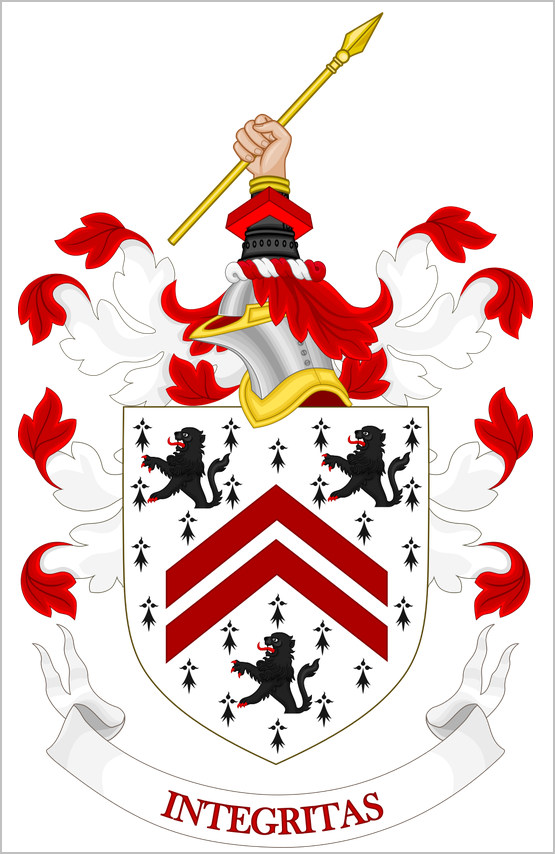
Trump’s coat of arms proclaims non-existent aristocratic blood:
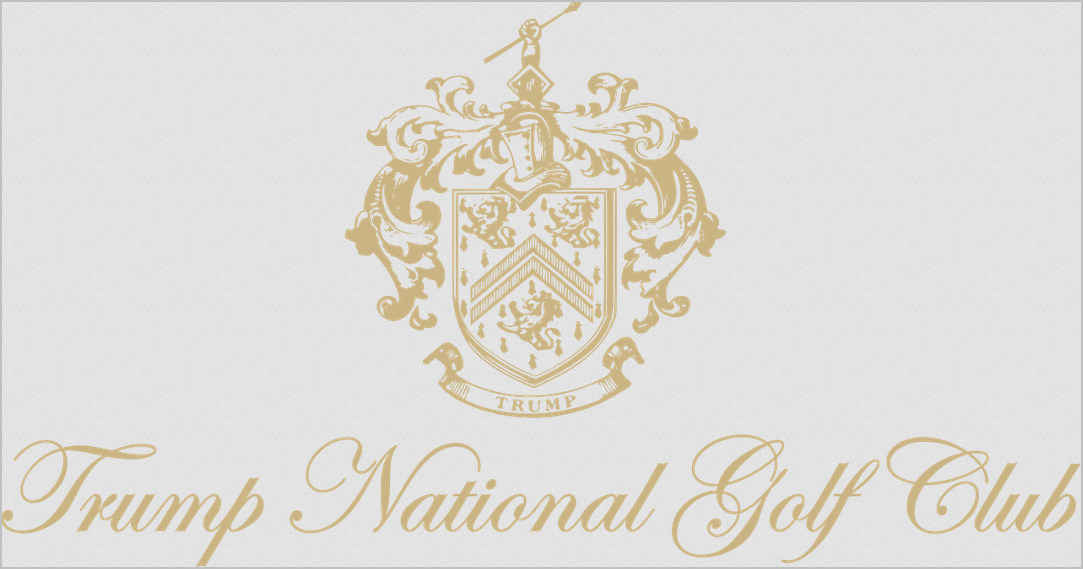
The Trump banner appropriates the coat of arms of the United States diplomat to the Soviet Union during World War II, Edward Davies[6], but removes the diplomat’s use of "Integritas", the Latin word for "integrity" and replaces "integrity" with Trump’s own name. A bold move of brazen narcissism.
National Embodiment By Name
Trump’s ten "national" institutions:
-
Trump National Golf Club Washington, D.C.
-
Trump National Golf Club Los Angeles
-
Trump National Doral Golf Club (Florida)
-
Trump National Golf Club Jupiter (Florida)
-
Trump National Golf Club Bedminster (New Jersey)
-
Trump National Golf Club Colts Neck (New Jersey)
-
Trump National Golf Club Philadelphia
-
Trump National Golf Club Hudson Valley (New York)
-
Trump National Golf Club Westchester (New York)
-
Trump National Golf Club Charlotte (North Carolina)
all identify his name with the nation. Why isn’t "Trump Golf Club" sufficient? Why must "National" be incorporated into the name?
Visual Embodiment As Flag
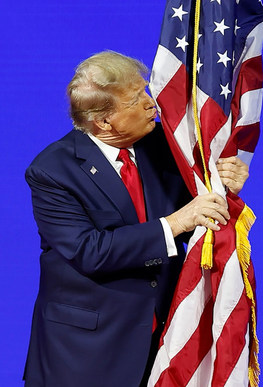
During his campaign to become the chief executive, Trump physically clutched the flag so he could hug and kiss it.
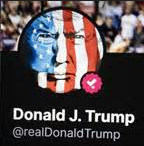
Once he became the chief executive, Trump went a step further: in his social posts, he merged his face into the flag.
Visual Embodiment As Crowd
The crowd embodies the Chief, and the Chief embodies the crowd:
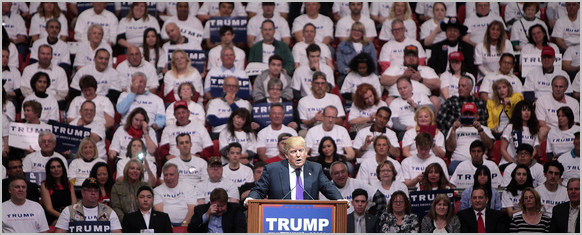
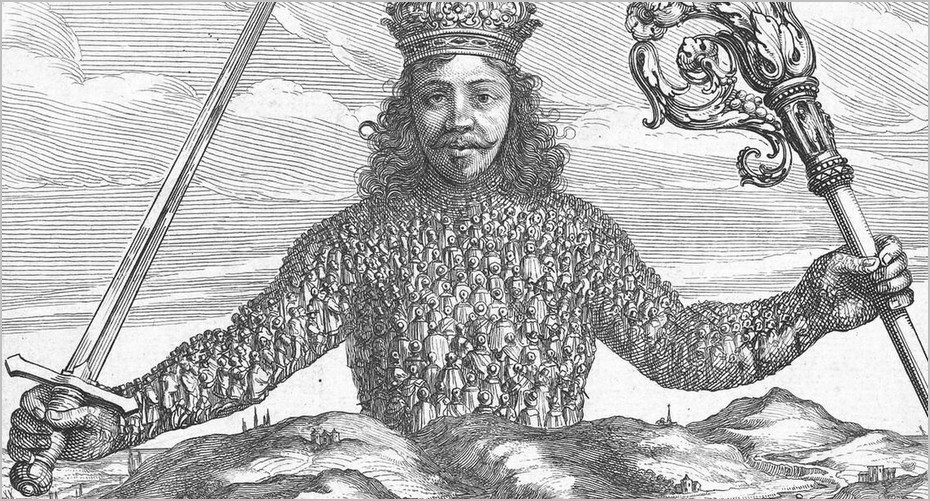
This harkens back to the absolute power of the monarchy advocated by Thomas Hobbes in the 1651 book, "Leviathan or The Matter, Forme and Power of a Commonwealth Ecclesiasticall and Civil", where the Chief’s body visually incorporates the bodies of those who dwell in England.[7].
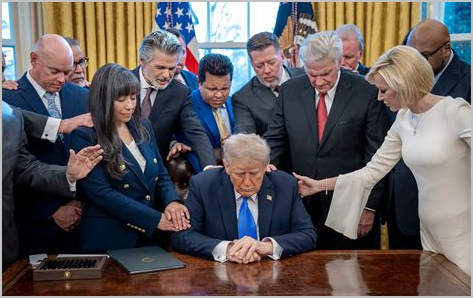
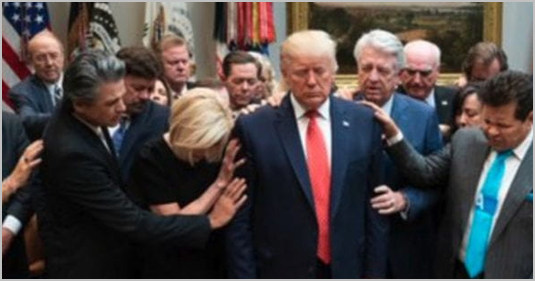
Did Mr. Trump, at least in his own mind, through the laying-on-of-hands by dozens of Evangelical Priests simultaneously[8] become a focal point for metaphysical capabilities, a channel for the Divine Will, a sort of living Saint without having to undergo martyrdom? Does Mr. Trump consider himself to be the national Messiah, the spiritually annointed one?
Does a political theology of the annointed one harkened back to Otto III of the Holy Roman Empire around the year 1000, blessed by the hand of God and angelic beings[9]:
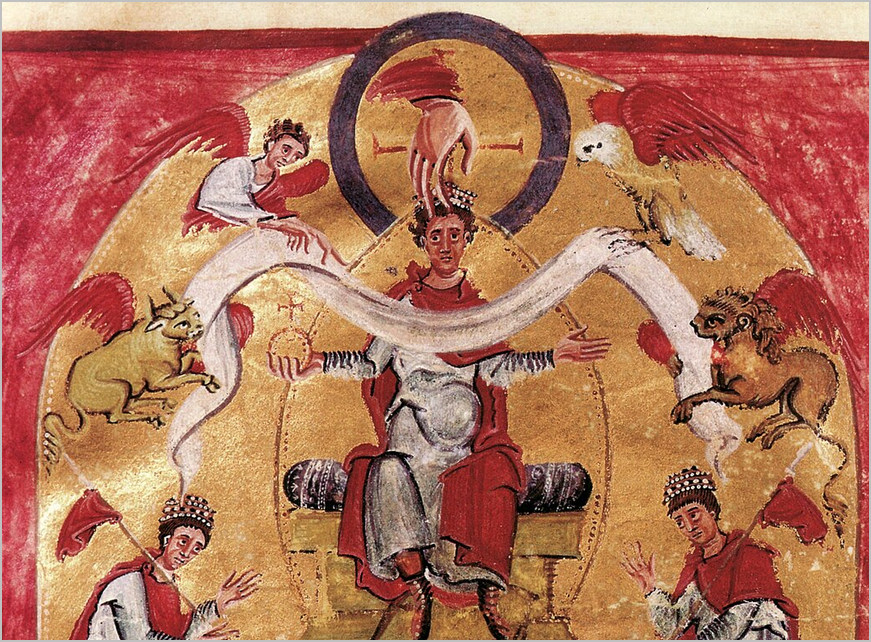
Does today’s King-like President, like the Emperor a thousand years ago, consider himself to be the mediator between God’s Divine Will and needs of the nation?
If so, might that metaphysical longing to transcend his mortal body and become immortal have lead the President away from the practical duties of the Presidental office? Have symbols and slogans replaced the constitutional Republic? Does Mr. Trump’s longing to have an eternal presence explain his focus is on signs and rebrandings that display the power to rename things (Gulf of Mexico, Kennedy Center, "Superior Intelligence"), and to construct large monuments (border wall, ballroom, triumphal arch)? Has the pragmatic Art of the Deal been replaced by the trivial Art of the Spectacle?
